Wild Deodorant Review: Is the Refillable Hype Worth It?
How We Researched ThisThis review is based on Wild's published ingredient lists and product pages, UK and US retailer listings (Boots, Tesco, Superdrug, Target), reporting on the Unilever acquisition, and patterns across thousands of public customer reviews. It is not based on our own product testing.
Wild deodorant is everywhere: on Boots shelves, in Target, and all over social media. The pitch is simple. Buy a good-looking case once, then top it up with plastic-free refills. But is the deodorant inside any good, how much plastic does it really save, and what changed when Unilever bought the brand? Here's what the evidence says.
Quick Verdict
A genuinely good natural deodorant with a real environmental benefit, as long as you pick the right formula. Most users rate the odour control and scents highly. The original stick contains baking soda, so if your skin is sensitive, go straight to the Sensitive range. It won't stop you sweating; for that, you need Wild's separate antiperspirant roll-on, which contains aluminium.
User reviews are broadly positive for everyday odour control. The stick doesn't reduce sweat; Wild's separate roll-on antiperspirant does.
One of the biggest scent ranges in natural deodorant, plus seasonal editions.
Starter pack about £13 at Boots or $17 at Target; refills about £6 and last 4–6 weeks. Easy to buy in both countries.
The original stick contains baking soda, which irritates some people. A baking-soda-free Sensitive range is available.
Pros
- Refillable aluminium case with compostable, plastic-free refills
- Huge scent range and easy to buy on the UK high street and at Target
- Baking-soda-free Sensitive range for reactive skin
Cons
- The original stick contains baking soda, a common cause of rash
- It won't reduce sweat (only the separate antiperspirant roll-on does)
- Some users report white marks on dark clothes
How we score. Scores are our editorial judgement from research, not a lab or wear test. Effectiveness: how the product works (antiperspirant or deodorant), the strength of its active ingredient, and how consistent large numbers of user reviews are. Scent: the range of scents, including a fragrance-free option, and how users rate them. Value: price, and how easy it is to buy in the US and the UK. Skin Safety: known irritants in the formula, sensitive-skin options, and how often irritation is reported. The overall score is the average of the four. We will update scores if we test products ourselves.
1Who Makes Wild?
Wild is a British brand that launched in 2020 with a single idea: remove single-use plastic from the bathroom. It started with refillable deodorant and has since added body wash, lip balm and a kids' range. Wild is a certified B Corporation, and its formulas are vegan and cruelty-free.
On 1 April 2025, Unilever announced it had bought Wild. Unilever already owns Dove, Sure and Rexona, so Wild now sits alongside some of the biggest antiperspirant brands in the world. The price wasn't disclosed, but media reports valued the business at about £230 million. At the time, Wild was sold mainly in the UK, Europe and the US, where its sales had tripled in two years.
Co-founder Charlie Bowes-Lyon said the deal would "hugely strengthen" Wild's plastic-free mission, and Wild says its B Corp, vegan and cruelty-free commitments continue. We haven't seen evidence of formula changes to the stick since the acquisition. The big change is the product range: Wild now sells an antiperspirant roll-on, which contains aluminium (more on that below).
2How the Refill System Works
You buy a starter pack: a reusable case plus your first refill. The case is made from aluminium with recycled plastic inside, and it's designed to last for years. After that, you only buy refills. Each 40g stick refill comes in a compostable bamboo-pulp casing rather than a plastic tube.
How to refill Wild deodorant
These are Wild's own instructions for its current case:
- Twist the base to the left until it won't turn any further
- Pull the base straight out of the case (the current case has no buttons)
- Remove the empty refill and press the new one firmly onto the base
- Slide the case back over the refill
- Twist the base to the right to raise 2–3mm of product, then apply a few swipes to clean, dry underarms
Wild says empty refills can be home composted or put in paper recycling. Store spare refills somewhere cool and dry, out of direct sunlight, because natural sticks soften in heat.
You can buy refills one at a time or on a subscription, which Wild discounts by 20% in the UK and US. Subscriptions are convenient but easy to forget about, so set a reminder to review your delivery schedule. Some Trustpilot reviewers complain about unexpected renewals.
3★ How Much Plastic Does Wild Actually Save in a Year?
Wild's marketing talks about plastic saved, but nobody shows the maths for a single person over a year. Here it is, with every assumption labelled.
Step 1: How many refills do you use a year?
Wild says each 40g refill lasts about 4 to 6 weeks with daily use. That's roughly 9 to 13 refills a year.
Step 2: How much plastic does each refill replace?
This is where it gets interesting, because Wild's own figures don't agree:
- Wild's US website says each refill saves "over 30g" of plastic.
- Wild's packaging announcement said more than 40 million stick refills had saved 720 tonnes of disposable alternatives. That works out at about 18g per refill.
We use both as the low and high ends of a range, because there's no independent measurement of a "typical" plastic deodorant stick to settle it.
Step 3: The yearly saving
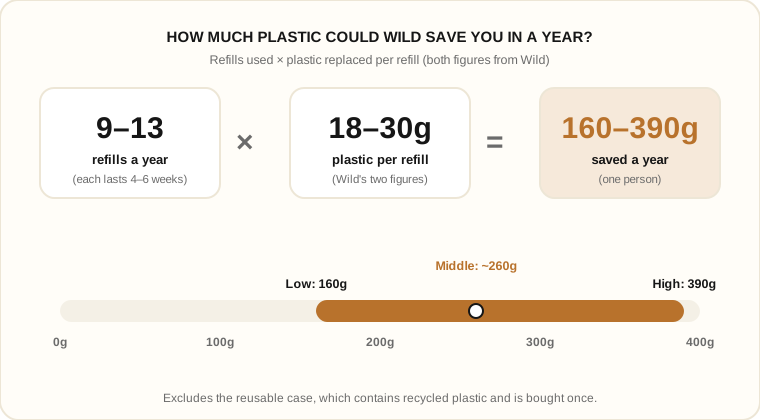
| Scenario | Refills a year | Plastic per refill | Plastic saved a year |
|---|---|---|---|
| Low estimate | 9 | 18g | about 160g |
| Middle estimate | 11 | 24g | about 260g |
| High estimate | 13 | 30g | about 390g |
So a year of Wild saves roughly 160g to 390g of plastic for one person, based on Wild's own per-refill figures. That's a real saving, but put it in context:
- The case itself contains recycled plastic, which you buy once. The longer you keep it, the better the trade-off.
- The figures assume the refill replaces a full plastic stick. If you were using an aerosol or a glass roll-on before, the comparison is different.
- The biggest benefit is cumulative: the same case can last for years of refills.
4What's Inside: Ingredients and Formulas
Wild sells three different products, and the differences matter more than the scent you pick.
| Product | Odour/sweat control | Aluminium? | Baking soda? | Best for |
|---|---|---|---|---|
| Original stick | Baking soda, magnesium hydroxide, zinc ricinoleate | No | Yes | Most people wanting natural odour control |
| Sensitive stick | Magnesium hydroxide, zinc ricinoleate, rice starch | No | No | Reactive skin or a past baking-soda rash |
| Roll-On Antiperspirant | Aluminium sesquichlorohydrate (10% actives) | Yes | No | People who need to sweat less |
The stick's base is made of caprylic/capric triglyceride, tapioca starch, coconut oil, sunflower wax, and shea and cocoa butters, plus fragrance. Wild describes its formulas as 90% or more natural-origin, and all are vegan.
Wild built its name on natural, aluminium-free deodorant, but its newer Roll-On Antiperspirant contains aluminium sesquichlorohydrate, the active ingredient that reduces sweat. It also claims 72-hour protection. If avoiding aluminium is your priority, buy the stick. For what the research says about aluminium, see our guide to whether aluminium in deodorant is bad for you.
5Does Wild Deodorant Actually Work?
On the evidence available, yes, for most people's day-to-day odour control. Wild's Trustpilot score is 4.5 out of 5 from more than 100,000 reviews (October 2026). That rating covers the whole company, including delivery and customer service, but product performance and scent are among the most praised themes. Wild also says its stick was named a Which? Best Buy for natural deodorant in May 2026.
The recurring complaints are consistent too:
- Rash with the original formula. Several long-term reviewers report underarm irritation that cleared after switching to the Sensitive range. That fits what we know about baking soda, which is far more alkaline than skin (see our homemade deodorant guide for the chemistry).
- White marks on dark clothes. The stick can transfer if you apply too much. Two gentle swipes and a minute to dry help.
- Refills running out faster than expected for people who apply heavily. Wild's 4–6 week estimate assumes two gentle swipes per underarm.
- Softening in heat. Like most natural balm-sticks, refills soften in hot weather or a steamy bathroom.
Remember that the stick is a deodorant, so it won't reduce how much you sweat. If you're switching from an antiperspirant, expect a couple of weeks of adjustment. Our best natural deodorant guide explains what to expect and compares Wild with other natural brands.
6Is Wild Really Plastic-Free?
Mostly, but the precise claim is "single-use-plastic-free". The stick refills are wrapped in compostable bamboo pulp, and the roll-on refills come in a compostable bottle made from a plant-based bioplastic (PHA) with an aluminium cap. The reusable case, though, is made from aluminium with recycled plastic inside. That's a sensible design, since you keep the case for years, but it does mean the system isn't 100% plastic-free.
7Where to Buy Wild in the UK and US
In the UK, Wild is easy to find. Starter packs and refills are sold at Boots, Tesco, Sainsbury's, Waitrose, Ocado and Morrisons, as well as on wearewild.com. When we checked in October 2026, a starter pack was £12.99 at Boots and single refills were around £6 (often less on offer). Wild's own site charges £1.99 for standard UK delivery and takes 20% off subscriptions.
In the US, Wild sells through Target, where a starter pack was $16.99 in October 2026, and through its own US website, wearewild.com/us, which runs a discounted starter-pack offer for new subscribers.
Our buy link is in the score card near the top of this review.
Want to compare Wild with other aluminium-free options?
See Our Best Aluminium-Free Deodorant Picks8Who Should (and Shouldn't) Buy Wild
- People who want a natural, aluminium-free deodorant they can buy in a normal shop
- Anyone trying to cut bathroom plastic without giving up a pleasant scent
- Sensitive skin: start with the Sensitive range, not the original stick
Heavy sweaters will get more from a clinical-strength antiperspirant, and budget shoppers can find aluminium-free sticks for less than a Wild refill. Our guide to the best deodorants covers both.
9Our Verdict
Wild earns its popularity. It's one of the few natural deodorants that's easy to buy in both the UK and the US, the scents are a genuine strength, and the refill system saves a real, if modest, amount of plastic: roughly 160g to 390g a year for one person on Wild's own figures. Choose carefully, though. The original stick contains baking soda, so sensitive skin should go straight to the Sensitive range, and the Roll-On Antiperspirant is the one product in the line that contains aluminium. Overall, we give it a research score of 7.5 out of 10.
10Frequently Asked Questions
QDoes Wild deodorant actually work?+
For everyday odour control, most users say yes. Wild has a Trustpilot rating of 4.5 out of 5 from more than 100,000 reviews (October 2026), although that covers the whole company, including delivery. The stick is a deodorant, not an antiperspirant, so it won't reduce sweat. Heavy sweaters may prefer Wild's roll-on antiperspirant or a clinical-strength product.
QIs Wild deodorant non-toxic and safe?+
Wild's stick deodorants are free from aluminium, parabens and phthalates, and the brand says they're made from 90% or more natural-origin ingredients. "Non-toxic" isn't a regulated term, though. The ingredient most likely to cause a reaction is baking soda in the original stick, so people with sensitive skin should start with the Sensitive range.
QWhat are the ingredients in Wild deodorant?+
The original stick is based on caprylic/capric triglyceride, tapioca starch, coconut oil, shea and cocoa butter, with sodium bicarbonate (baking soda), magnesium hydroxide and zinc ricinoleate for odour control, plus fragrance. The Sensitive range removes the baking soda and uses magnesium hydroxide, zinc ricinoleate and rice starch instead.
QIs Wild deodorant aluminium-free?+
The stick deodorants are. But Wild also sells a Roll-On Antiperspirant, which contains aluminium sesquichlorohydrate, because that's what reduces sweat. If avoiding aluminium is your goal, choose the stick, not the antiperspirant roll-on.
QHow do you refill Wild deodorant?+
Twist the base to the left until it stops, then pull the base out of the case. Remove the empty refill, press the new refill firmly onto the base, and slide the case back over it. Twist the base to the right to raise 2–3mm of product. Wild says empty refills can be home composted or put in paper recycling.
QWho owns Wild deodorant?+
Unilever, the company behind Dove, Sure and Rexona, bought Wild in April 2025. The price wasn't disclosed, but media reports valued the business at about £230 million. Wild says its B Corp, vegan and cruelty-free commitments continue.
QCan you buy Wild deodorant in the US?+
Yes. Wild sells in the US through its own website, wearewild.com/us, and through Target, where a starter pack was $16.99 when we checked in October 2026. Wild says its US sales tripled in the two years before the Unilever deal.