Best Natural Deodorant in 2026: 10 That Actually Work All Day
How We ReviewBased on thousands of verified UK customer reviews, independent lab data, and editorial analysis of ingredients, certifications, and retail availability. We do not accept payment from brands for placement.
Most "natural deodorant doesn't work" complaints aren't about the product — they're about timing. Switch from antiperspirant and your skin needs 1 to 3 weeks to recalibrate before odour control actually kicks in. Quit on day three, like most people do, and you'll never find out if the formula was right for you. We looked at the best natural deodorants UK shoppers buy most, tracked which ones hold up past the adjustment period, and put together a switch-over plan so you don't quit before the formula has a real chance to work.
⚡ Quick Verdict — Best Natural Deodorant UK 2026
Natural deodorant does not stop you sweating — it only targets odour-causing bacteria. If excessive sweating rather than smell is your main concern, a natural or non-toxic deodorant alone will not solve that. A dedicated antiperspirant is a different product solving a different problem.
1What Actually Makes a Deodorant "Natural"?
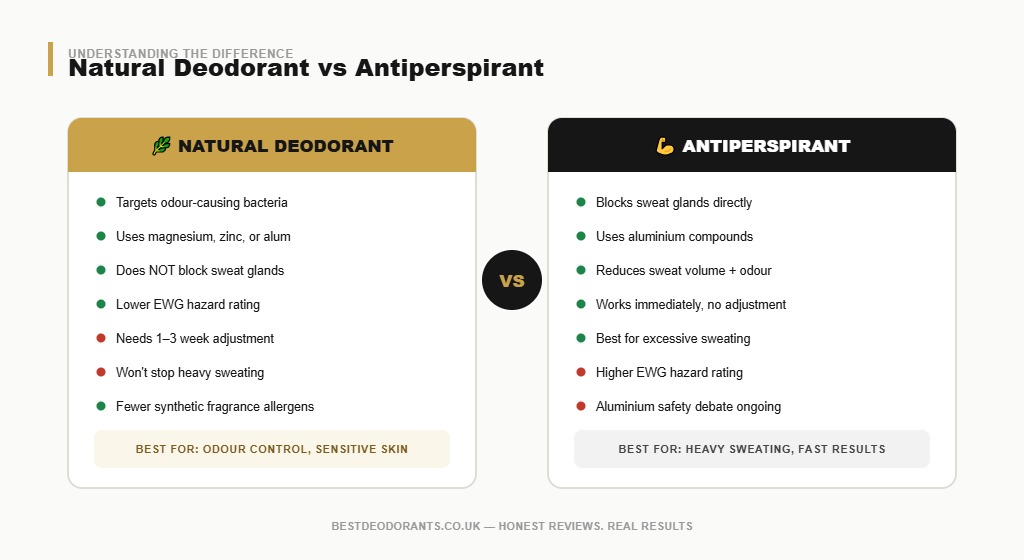
There is no legal definition of "natural" in UK cosmetics regulation, which is why every brand stretches it to suit themselves. Put simply, a natural deodorant swaps aluminium salts for ingredients like sodium bicarbonate, magnesium hydroxide, potassium alum, or zinc oxide — these absorb moisture and neutralise odour-causing bacteria rather than physically blocking the sweat glands.
This matters because the two products are solving fundamentally different problems. Aluminium-based antiperspirants block pores to reduce how much you sweat. Natural and aluminium-free deodorants let you sweat normally and instead target the bacteria that turn sweat into smell. Neither is inherently superior — they serve different needs. The same applies to organic deodorant and non-toxic deodorant: both labels refer to the absence of synthetic aluminium compounds, but the underlying odour-control mechanism is identical to any other natural formula.
The ingredient responsible for most natural deodorant complaints
If a natural deodorant has ever left you with a red, itchy rash within a few days, the reason is specific and well understood: sodium bicarbonate (baking soda) sits at a pH of roughly 8–9, while underarm skin sits at a mildly acidic pH of around 5.5. Use an alkaline ingredient on acidic skin every day and the mismatch gradually breaks down your skin barrier — triggering the classic baking soda deodorant rash that fills one-star reviews across every brand that uses it. If you'd rather control the ingredients yourself, our homemade deodorant recipes include a genuine baking-soda-free version.
This explains the majority of "natural deodorant gave me a rash" reviews online. It's not an allergy to natural ingredients broadly — it's a pH mismatch with one specific ingredient. Switch to a baking-soda-free deodorant rather than writing off the category entirely.
Key ingredients explained
Highly effective odour neutraliser — but its alkaline pH disrupts the skin's natural acid mantle. The most common cause of natural deodorant rash. Avoid if you have reactive or eczema-prone skin.
A gentler alternative that neutralises acidic odour compounds without disrupting skin pH. Used by Wild, Salt & Stone, and Curie. Rarely causes irritation and is the current industry standard for sensitive formulas.
A naturally occurring mineral salt that inhibits odour-causing bacteria without blocking pores. Lower EWG hazard rating than aluminium chlorohydrate. Used in Thai Crystal and Salt of the Earth crystal range.
Antibacterial and anti-inflammatory. The active ingredient in Lifelong Deodorant's sensitive-skin formula. Well-documented skin safety record. Ideal for baking-soda-free deodorant seekers.
Absorbs moisture without targeting odour directly. Helps formulas glide on smoothly without chalky residue. Almost universally well-tolerated. A standard supporting ingredient in most non-toxic deodorant formulas.
Contains lauric acid, which has mild antibacterial properties. However it has a comedogenic rating of 4/5 — can clog pores for some skin types. Worth noting if you're prone to underarm bumps.
2Our Top 10 Natural Deodorant Picks for 2026
| Brand | Key Ingredient | Format | Best For | Price |
|---|---|---|---|---|
| Wild Top Pick | Magnesium hydroxide | Refillable stick | Best overall — Which? Best Buy | £12.99 |
| Fussy Vegan | Probiotic, aluminium-free | Refillable stick | Best budget — 800+ UK stores | £10.99 |
| AKT London | Aluminium-free powder formula | Balm | Best for performance & heavy sweat | £24.00 |
| Salt of the Earth King's Award | Potassium alum (mineral salt) | Spray, roll-on, crystal | Best eco credentials | £8.99 |
| Lifelong Deodorant Sensitive | Zinc oxide + arrowroot | Refillable powder | Best for sensitive & eczema-prone skin | £14.50 |
| Green People COSMOS | Plant-based, Soil Association certified | Roll-on, spray | Best certified-organic deodorant | £9.50 |
| Neve's Bees | Unfragranced, bicarb-free | Stick | Best fragrance-free deodorant | £8.50 |
| Saltair | AHA + natural actives | Stick | Best skincare-led formula | £14.00 |
| Luna | pH-balanced, Symdeo + probiotics | Stick | Best whole-body use | £12.00 |
| Phlur | Salicylic acid + arrowroot | Stick | Best fragrance-forward aluminium-free | £18.00 |
The biggest shift in the UK natural deodorant market in 2026 is the dominance of refillable systems. Wild, Fussy, and Salt of the Earth all use a reusable outer case with replaceable inner refills. Salt of the Earth's refill system cuts plastic packaging by 85% per unit compared to buying three separate bottles — a figure independently verified and one of the reasons they were awarded the King's Award for Enterprise for Sustainable Development 2026. If sustainability matters to you, refillable deodorant is now the default in this market, not an exception.
3Natural Deodorant for Men vs Women: Is There a Difference?
The formula is usually identical. The difference is almost always fragrance and packaging. Natural deodorant for men and natural deodorant for women use the same active ingredients — magnesium hydroxide, arrowroot, baking soda — in the same concentrations. What varies is the scent profile and whether the marketing features a man or a woman on the box.
🧔 Natural Deodorant for Men
- Same active ingredients as women's
- Scents lean woodsy, sport, or citrus
- Top picks: Wild, AKT London, Dr. Squatch
- Fussy and Salt of the Earth both unisex
- Typically £8–£24 — same price range
👩 Natural Deodorant for Women
- Same active ingredients as men's
- Scents lean floral, clean, or sweet
- Top picks: Wild, Curie, Neve's Bees
- Lifelong is the top sensitive-skin pick
- Worth checking: some brands charge more
Several brands charge 10–15% more for women's variants of identically-formulated natural deodorants. Wild and Fussy both use fully gender-neutral pricing — worth factoring in if you're buying in bulk or on subscription.
4The 30-Day Transition: What Nobody Tells You Before You Switch
Every brand glosses over this part, and it's the real reason most people give up within a week. Your body has adapted to antiperspirant over years — it physically blocks your sweat glands. When you stop, they don't just reset overnight. There's a rebound period — the natural deodorant adjustment period — where you may sweat and smell more than usual, typically lasting one to three weeks. If a previously reliable deodorant suddenly seems to have stopped working rather than just adjusting, our troubleshooting guide covers the other common causes.
Brands rarely talk about the natural deodorant transition timeline because it puts buyers off. Skipping it is exactly why so many people conclude "natural deodorant doesn't work" after a five-day trial.
Expect more odour than usual — this is normal
Your skin's bacterial balance is recalibrating after years of antiperspirant use blocking sweat glands. Do not judge the product yet. Do not switch brands.
Baking soda reactions typically appear now
Redness, tightness, or small bumps under the arm are the signal to switch to a baking-soda-free formula — not to abandon natural deodorant entirely. Try Lifelong Deodorant or Neve's Bees instead.
Odour control starts catching up
Most people find this is when a natural deodorant that works genuinely starts living up to its promise. Sweat volume itself stays higher than antiperspirant — that's expected and permanent.
Your microbiome has largely readjusted
This is the accurate assessment point — not day three. Still struggling? The formula is likely the mismatch, not natural deodorant as a category. Try switching the active ingredient: magnesium instead of baking soda, or potassium alum instead of magnesium.
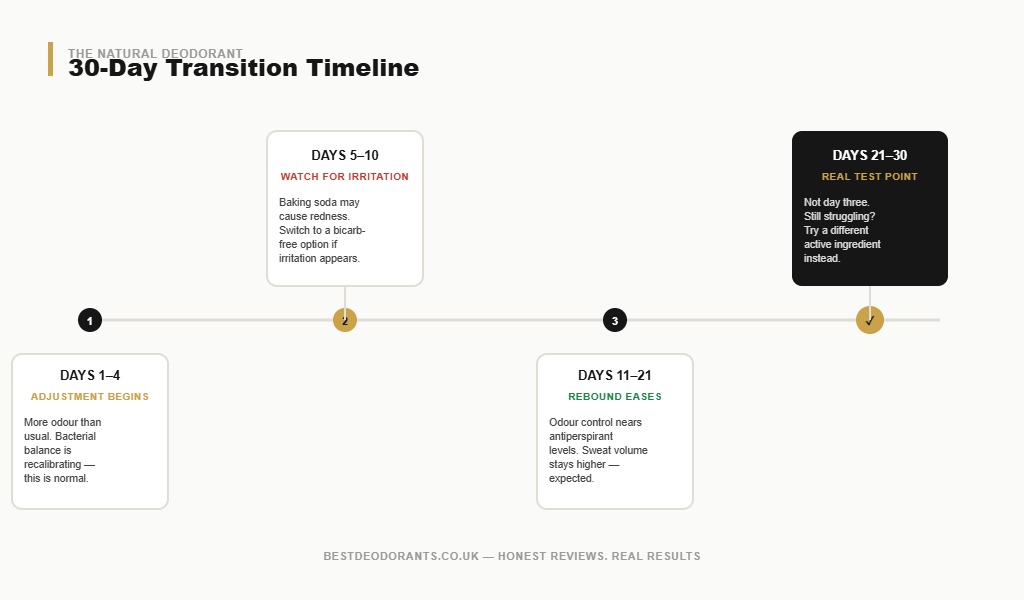
Don't judge a natural deodorant in the first week. If you're still struggling at the one-month mark, the ingredient — not the category — is the mismatch. Switch the active, not the brand.
5Is Natural Deodorant Actually Safer Than Antiperspirant?
This is the question driving most people toward "natural" in the first place, and the honest answer is more nuanced than the marketing suggests. The EWG Skin Deep database — a widely cited cosmetics hazard-rating resource — generally scores magnesium hydroxide and potassium alum as lower-risk than aluminium chlorohydrate or aluminium zirconium. But a lower EWG score is not the same as "clinically proven safer."
Much of the aluminium-cancer concern stems from theoretical mechanisms studied in lab settings rather than confirmed causal links in humans. Current NHS guidance does not support a link between aluminium-based antiperspirants and breast cancer, and both UK and US regulatory bodies continue to permit their use. What is more clearly established: natural formulas avoid synthetic fragrance allergens and certain preservatives — a real, separate benefit for people with reactive skin, entirely independent of the aluminium debate.
The best aluminium-free deodorant and best non-toxic deodorant for you is ultimately the one that works for your skin type and your body chemistry. For most people, that starts with avoiding baking soda if you have reactive skin, and giving any new formula a genuine 21-day trial before deciding.
6Natural Deodorant for Sensitive Skin: What to Look For
If you've had a reaction to natural deodorant before, the answer usually isn't to give up on it — it's avoiding the two most common irritants: sodium bicarbonate and synthetic fragrance. Here's what to look for in a natural deodorant for sensitive skin specifically:
- Baking-soda-free deodorant formula — Lifelong Deodorant and Neve's Bees are the UK's clearest sensitive-skin specialists. Both build around zinc oxide or potassium alum.
- Fragrance-free deodorant option — synthetic fragrance is the second most common irritant in deodorant after baking soda. Neve's Bees and Vanicream both offer completely unfragranced formulas — a true fragrance-free deodorant that's safe for MCS and fragrance-allergy sufferers.
- Vegan deodorant and cruelty-free certification — if this matters to your decision, Fussy, Wild, and Green People are all certified vegan. Check the Leaping Bunny database for verified cruelty-free status.
- Third-party certification — Soil Association or COSMOS certification (Green People) gives you an independent trust signal beyond brand marketing.
- Refillable powder systems — require fewer preservatives than pre-mixed sticks that sit in a tube for months, reducing overall chemical load for reactive skin.
- Patch test before use — apply to the inner arm for 48 hours before your first underarm use, particularly if you have a history of contact dermatitis or eczema.
7Where to Buy Natural Deodorant in the UK
Natural deodorant availability has changed significantly in the past two years — it's no longer a health-food-shop niche. Most of the brands in our top 10 are now stocked in mainstream UK retail:
AKT London and Lifelong Deodorant are primarily sold direct via their own websites, with Amazon UK as a secondary option. Factor in delivery time if you're trying either for the first time — neither is available same-day from a high street store currently.
If you're switching to Wild or Fussy, buy the starter kit (case + first refill) from their own website first — it's cheaper than buying via Amazon. Subsequent refills are significantly less expensive than the initial case purchase, so the cost-per-use drops considerably after month one.
8Our Verdict
If you're switching from antiperspirant and you're not sure where to start, Wild is the most straightforward option — it has independent Which? Best Buy verification, is stocked at Boots and Waitrose, uses a magnesium hydroxide formula that is consistently gentle, and its refillable case system is the most widely available sustainable deodorant format in UK retail.
If baking soda has caused problems for your skin before, go straight to Lifelong Deodorant or Neve's Bees rather than spending weeks troubleshooting irritation on a formula that was never going to suit you. And if you're someone who sweats heavily rather than simply wanting better odour control, the honest answer is that a best non-toxic deodorant or all natural deodorant is not designed to solve that problem — that's a job for a clinical-strength antiperspirant, not a magnesium-based formula.
Compare every deodorant category we cover:
Browse All Reviews on BestDeodorants.co.uk9Frequently Asked Questions
QDoes natural deodorant really work?+
Yes, for odour control — that's what it's designed to do. It doesn't reduce sweating the way an antiperspirant does. Expect a 1–3 week natural deodorant transition period before judging effectiveness accurately. Baking-soda-free formulas are better tolerated by sensitive skin and still work reliably for odour control.
QWhy does natural deodorant smell worse for the first few days?+
Your skin's bacterial balance is recalibrating after years of antiperspirant blocking sweat glands. This natural deodorant adjustment period is temporary and typically resolves within two to three weeks. It is not a sign the product isn't working — it's your body returning to its baseline.
QIs baking soda in deodorant bad for your skin?+
Not for everyone. But its alkaline pH — around 8 to 9 — is why baking soda deodorant rash is so common in people with sensitive skin. If you notice redness or itching within the first two weeks, switch to a baking-soda-free deodorant formula rather than persevering.
QWhat is the best non-toxic deodorant?+
Wild is our overall pick based on verified independent testing (Which? Best Buy 2026), UK retail availability, and EWG ingredient transparency. For sensitive skin specifically, Lifelong Deodorant is the clearest recommendation — zinc oxide formula, baking-soda-free, and fragrance-free option available.
QIs natural deodorant better than aluminium-free deodorant?+
They're usually the same product described two different ways. "Aluminium-free deodorant" is a more precise term — it specifically describes what's absent. "Natural deodorant" is a broader marketing label with no fixed UK legal definition. Read the ingredient list rather than trusting either label.
QDoes natural deodorant work for heavy sweaters?+
Not as effectively as a proper antiperspirant, no. If you sweat heavily, a magnesium-based or baking-soda-free natural deodorant will control odour but will not significantly reduce sweat volume. AKT London is the natural option most often cited by heavy sweaters as the most effective — but it is still not a replacement for an aluminium-based antiperspirant if excessive sweating is your primary concern.
QAre vegan deodorants different from other natural deodorants?+
Vegan deodorant simply means no animal-derived ingredients — no beeswax, no tallow, no lanolin. Many natural deodorants are not vegan by default because they use beeswax as a base. Fussy, Wild, and Green People are all certified vegan and are otherwise identical in function to non-vegan natural formulas.