Antiperspirant vs Deodorant: What's Actually the Difference?
How We ReviewBased on dermatological literature, FDA and NHS classification guidance, and editorial research, cross-checked against ingredient data. We are not paid by any brand for placement in this article.
Most people use "antiperspirant" and "deodorant" interchangeably, and most packaging doesn't help — plenty of sticks are labelled "antiperspirant deodorant" as if it's one thing. It isn't. They work on two different gland types, solve two different problems, and are even regulated differently depending on which country you're in. Once you see the actual mechanism behind each one, the confusion mostly disappears — so that's where we're starting.
Quick Answer
Antiperspirant reduces how much you sweat. Deodorant only controls the smell. Antiperspirant uses aluminium salts to temporarily plug the eccrine sweat ducts. Deodorant does nothing to sweat volume at all — it targets the bacteria that turn apocrine gland secretions into body odour, usually backed up by fragrance. A product labelled "antiperspirant deodorant" simply contains both types of active ingredient in one formula.
Both products are applied to the same spot, at the same time, from containers that often look identical. Manufacturers rarely explain the difference on-pack because most combination products don't need the buyer to understand the mechanism — they just need it to work. That's left a lot of genuine confusion about what each one actually does.
1Two Gland Types, Two Completely Different Jobs
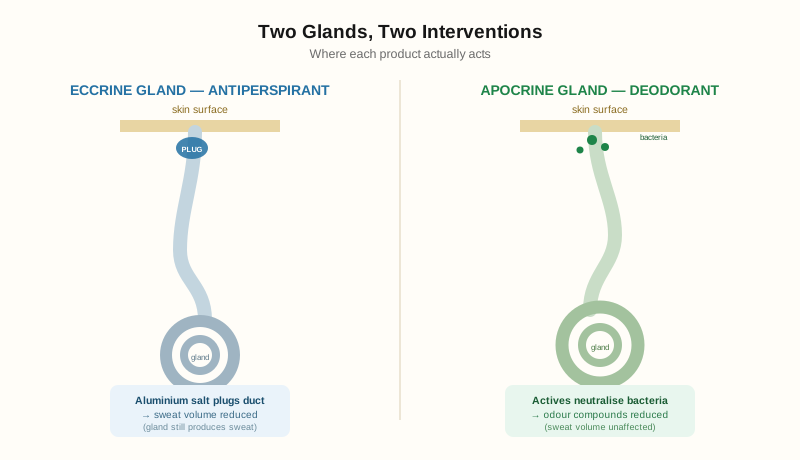
Underarm skin has two kinds of sweat gland doing unrelated jobs, and each product targets a different one. Eccrine glands are spread across almost your entire body and produce the thin, mostly water-based sweat responsible for cooling you down — it's largely odourless on its own. Apocrine glands are concentrated in the underarms, groin, and a few other hair-follicle-dense areas, and don't become active until puberty. Their secretion is thicker, containing proteins and lipids — and when skin bacteria break those down, the by-products are what actually smell.
This is the single fact that explains almost everything else in this article: antiperspirant works on eccrine glands to reduce sweat volume. Deodorant works on the bacteria feeding on apocrine secretions to reduce odour. Neither product does the other's job, no matter how strong the formula is.
🧪 Antiperspirant targets:
- Eccrine sweat glands
- Sweat volume and wetness
- Uses aluminium-based active ingredients
- Classed as an OTC drug in the US
🌿 Deodorant targets:
- Bacteria on apocrine secretions
- Odour, not sweat volume
- Uses antibacterial agents, odour-neutralisers, fragrance
- Classed as a cosmetic everywhere
2How Antiperspirant Actually Works
Nearly every antiperspirant on the market uses some form of aluminium salt — aluminium chlorohydrate, aluminium zirconium tetrachlorohydrex gly, or aluminium sesquichlorohydrate, depending on the strength. On contact with the moisture in your eccrine duct, these compounds partially dissolve and react with proteins lining the duct wall, forming a temporary gel plug near the skin's surface. That plug physically restricts how much sweat reaches the surface — the gland itself keeps producing sweat, it just can't get out as easily.
This is a genuine physical intervention on a bodily function, which is exactly why the US FDA classifies antiperspirant as an over-the-counter drug rather than a cosmetic, requiring the aluminium compound to be listed as an "Active Ingredient" in the same format used on medicine packaging. We've covered the safety question behind this mechanism in full in our aluminium safety breakdown, including a compound-by-compound risk comparison.
3How Deodorant Actually Works
Deodorant doesn't touch the sweat duct at all. Instead it works on the skin's surface and the bacteria living there, usually through a combination of three mechanisms: antibacterial agents that reduce the bacteria population feeding on apocrine secretions, odour-trapping ingredients like cyclodextrin (a ring-shaped molecule that physically captures odour compounds rather than killing bacteria) or zinc ricinoleate (which binds to odour molecules and raises the threshold at which your nose detects them), and fragrance to mask whatever smell gets through.
None of this changes how much you sweat. A deodorant applied to someone who sweats heavily will do exactly what it's designed to do — control odour — while doing nothing at all about visible wetness. That's the most common source of disappointment when people expect a deodorant to perform like an antiperspirant.
4Why They're Regulated Completely Differently
In the US, this distinction has real legal weight. Antiperspirant is regulated by the FDA as an over-the-counter drug under 21 CFR Part 350, because it alters a physiological function. Deodorant is regulated as a cosmetic, the same category as lipstick or shampoo, with a much lighter compliance burden. This split means the two products are quite literally tested, labelled, and approved through entirely different regulatory pathways in America.
In the UK and EU, the picture is different — both antiperspirant and deodorant fall under general cosmetics regulation, enforced by the Office for Product Safety and Standards rather than a medicines regulator. However, aluminium concentration limits are still specifically capped under that cosmetics framework, so the ingredient itself receives its own safety scrutiny even without the US-style drug classification.
When a product is labelled this way, it simply means the formula contains both an aluminium-based antiperspirant active and deodorant ingredients like fragrance or odour-neutralisers side by side. Both mechanisms run independently in the same stick — it's two products merged, not a new one invented.
5Which One Do You Actually Need?
This comes down to one honest question: is your main complaint wetness, or is it smell? The two symptoms have completely different products behind them.
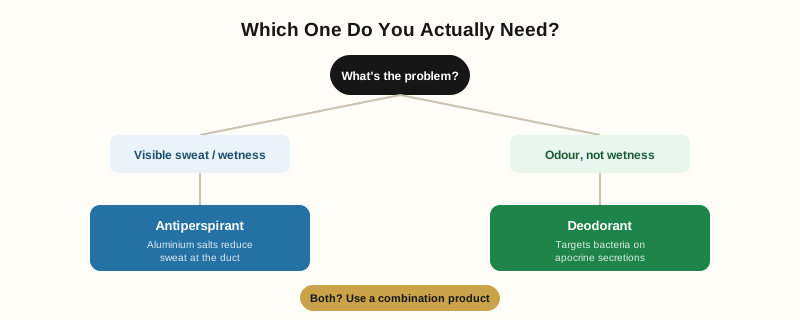
- You mainly want to stop smelling — a deodorant alone is enough. You'll still sweat normally, but odour should be well controlled.
- You visibly sweat through clothing — you need an antiperspirant. No deodorant, however strong the fragrance, will reduce sweat volume.
- You want both handled at once — a combination "antiperspirant deodorant" product covers both mechanisms in a single application.
- You've switched to aluminium-free and miss the dryness — that's expected. Aluminium-free deodorants, including natural ones, do not reduce sweat; only an aluminium (or prescription aluminium chloride) active does that.
- Standard antiperspirant isn't enough — clinical-strength formulas use a higher aluminium concentration, and prescription-strength options exist beyond that for genuine hyperhidrosis.
6Our Verdict
The confusion between these two products is entirely understandable given how they're packaged and marketed, but the underlying mechanism is genuinely simple once you see it laid out: one plugs a duct, the other manages bacteria. Neither is a stronger or weaker version of the other — they're solving different problems using different biology, and picking the right one just means being honest about which problem you actually have.
If sweat volume is the issue, don't expect a deodorant — even a "natural" or premium one — to fix it. Our best antiperspirant deodorant guide compares actual aluminium concentrations across the main clinical-strength options, if that's the direction you need. And if odour is your only concern, a full-strength clinical antiperspirant is solving a problem you don't have. For more on the natural deodorant side of this decision, see our Best Natural Deodorant guide, including the realistic adjustment period when switching away from aluminium.
Wondering if the aluminium in antiperspirant is something to worry about?
Read Our Full Aluminium Safety Breakdown7Frequently Asked Questions
QWhat is the actual difference between antiperspirant and deodorant?+
Antiperspirant reduces how much you sweat by temporarily blocking the eccrine sweat ducts with aluminium salts. Deodorant does not affect sweat volume at all — it targets the bacteria on your skin that turn apocrine sweat into odour, usually combined with fragrance to mask any remaining smell. They solve two different problems using two different mechanisms.
QIs antiperspirant just a stronger deodorant?+
No — this is a common misconception. Antiperspirant isn't a stronger version of deodorant; it's a fundamentally different product that happens to often be combined with deodorant in the same stick. Antiperspirant physically reduces sweat production. Deodorant only affects odour, no matter how much of it you apply.
QHow does antiperspirant deodorant work when they're combined?+
Combination products contain both an aluminium-based antiperspirant active, which plugs the eccrine sweat ducts to reduce sweat, and deodorant ingredients like fragrance, antibacterial agents, or odour-trapping compounds such as cyclodextrin, which neutralise the bacteria-driven smell from apocrine glands. Both mechanisms run side by side in the same formula.
QIs Native deodorant an antiperspirant?+
No. Native's core range is deodorant only — it contains no aluminium compounds and will not reduce how much you sweat. It uses ingredients like tapioca starch and coconut oil to absorb moisture and fragrance or odour-neutralisers to manage smell. If sweat volume is your main concern, Native alone will not solve that.
QWhy are antiperspirants regulated differently to deodorants?+
In the US, the FDA classifies antiperspirant as an over-the-counter drug because it changes a bodily function — sweat production — rather than just masking a cosmetic issue like smell. Deodorant is classed as a cosmetic. In the UK and EU, both are regulated as cosmetics, but antiperspirant's aluminium concentration is still capped separately under cosmetics safety rules.
QCan you use deodorant and antiperspirant at the same time?+
Yes, and it's common — many people layer a separate deodorant over an antiperspirant, or simply use a combination product that contains both. There's no conflict between the two mechanisms since one targets sweat ducts and the other targets bacteria and odour.