Does Deodorant Cause Cancer? Here's What the Research Says
How We ReviewBased on named, peer-reviewed studies cited by the National Cancer Institute, American Cancer Society and Cancer Research UK, cross-checked against the original papers where available. This is general health information, not medical advice. We are not paid by any brand for placement in this article.
Search this question and most sites tell you "research shows no clear link" without ever naming which research. That's not good enough for a topic this searched. So instead of a vague summary, this article names the actual studies — who ran them, when, on how many people, and what they actually concluded — so you can judge the evidence yourself rather than take our word, or anyone else's, for it.
Quick Answer
No study has established that deodorant or antiperspirant causes cancer in humans. The largest and most cited investigation — a 2002 case-control study of over 1,600 women — found no increased breast cancer risk from antiperspirant or deodorant use. Some smaller lab studies have found aluminium and parabens behave in concerning ways in isolated cells, which is why the theory persists, but that's a meaningfully different claim from proven human risk.
The deodorant-cancer link traces back to a chain email that circulated in the late 1990s, well before any of the studies below were published. The scientific research came afterward, partly in response to public concern the email had already created — which is part of why the topic has stayed alive online regardless of what the studies actually find.
1The Studies, Named — Not Just "Research Shows"
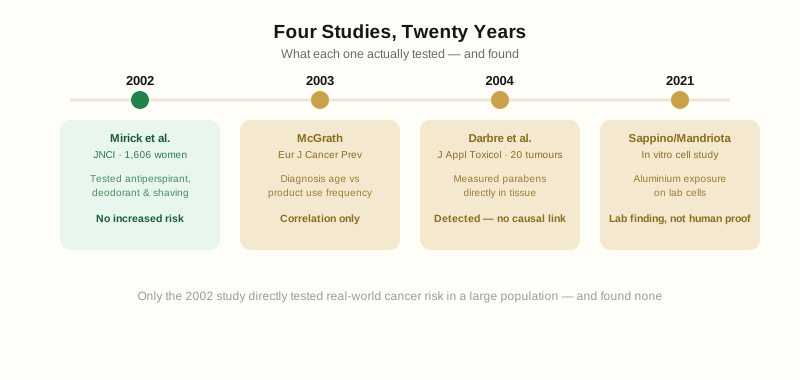
Here is every major named study that has actually investigated this question, in chronological order, with what each one really found:
| Study | Year | What it looked at | Conclusion |
|---|---|---|---|
| Mirick, Davis & Thomas (J Natl Cancer Inst) |
2002 | 813 breast cancer cases vs 793 controls, antiperspirant/deodorant use and shaving habits | No increased risk found |
| McGrath (Eur J Cancer Prev) |
2003 | Age at breast cancer diagnosis vs frequency of underarm product use and shaving | Earlier diagnosis age correlation only |
| Darbre et al. (J Appl Toxicol) |
2004 | Parabens measured directly in 20 human breast tumour samples | Detected in 19/20 — no causal link shown |
| Sappino & Mandriota (in vitro studies) |
2021 | Aluminium salt exposure on hamster and human breast cells in the lab | Cellular changes observed in vitro |
2The Strongest Evidence Against a Link: Mirick, 2002
This is the study major health bodies lean on most heavily, and for good reason: it's the largest and most methodologically solid investigation done on this specific question. Researchers compared 813 women with breast cancer to 793 women without, interviewing each about antiperspirant and deodorant use, shaving habits, and how soon after shaving they applied product. The results showed no increased risk associated with antiperspirant use, deodorant use, or applying either within an hour of shaving with a blade razor — directly testing, and not confirming, the "micro-cuts let chemicals in" theory that still circulates today.
3The Parabens Study: What Darbre 2004 Actually Showed — and Didn't
This is the study behind most "parabens found in breast tumours" headlines, and it's worth understanding exactly what it did. Dr Philippa Darbre and colleagues directly tested tissue from 20 human breast tumours and found at least one paraben ester present in 19 of them. That's a genuine, peer-reviewed finding — parabens can and do end up in breast tissue.
What the study could not do is just as important: it had no non-cancerous tissue to compare against, so there was no way to know whether paraben levels in tumours were any different from paraben levels in healthy tissue. It also couldn't identify the source of the parabens — they're used in far more than just deodorant, including food and pharmaceuticals — or establish any causal role in the tumours' development. Darbre's own team acknowledged this directly, and a formal response published in the same journal by Jeffrey and Williams challenged the study on exactly these grounds.
The FDA notes that most major deodorant and antiperspirant brands in the US have removed parabens from their formulas, largely in response to this exact concern. Check the ingredient list if this is a specific worry for you — many products will already say "paraben-free" on the label.
4The 2021 Lab Studies: A Real Finding, But Not the One Headlines Suggested
In 2021, researchers led by André-Pascal Sappino and Stefano Mandriota published in vitro work showing that hamster and human breast cells exposed to aluminium salts in the lab rapidly absorbed the metal and showed changes the researchers described as consistent with malignant transformation. Media coverage at the time ran with headlines suggesting antiperspirant had been newly "confirmed" to cause cancer.
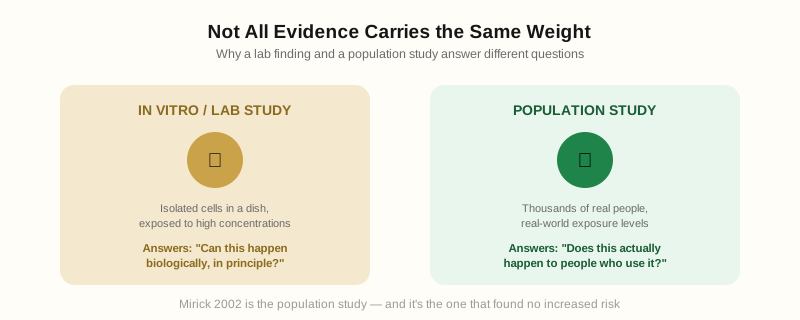
That framing overstates what in vitro research can actually establish. Exposing isolated cells in a dish to a substance and observing changes is a genuinely useful early step in toxicology, but it's a long way from demonstrating that real-world antiperspirant use, at real-world exposure levels, causes cancer in living humans — which is exactly what the large population studies like Mirick 2002 have specifically tested for and not found.
5Why "Correlation" Studies Keep Causing Confusion
The McGrath 2003 study is a good example of how a real, published finding gets misread. It found that women who used underarm products and shaved more frequently were, on average, diagnosed with breast cancer at a slightly earlier age. It did not find that they got breast cancer more often — only that diagnosis skewed earlier in more frequent users. That's a correlation between two behaviours, not evidence that one causes the other; plenty of unmeasured factors (screening habits, lifestyle, awareness) could explain the pattern just as easily.
A similar pattern shows up in a 2017 Austrian study sometimes cited online: it found an association only in a small subgroup — women under 30 who used antiperspirant multiple times daily — based on self-reported use. The researchers themselves flagged the self-reporting and subgroup size as limitations. Isolated subgroup findings like this are exactly the kind of result that needs replication before it means very much, and it hasn't been replicated at scale.
- A lab finding in cells is not the same as a confirmed risk in humans
- A correlation between two behaviours is not the same as one causing the other
- A small subgroup result needs replication before it's treated as established
- "Detected in tissue" is not the same as "shown to cause the disease in that tissue"
6What Major Health Bodies Currently Conclude
The National Cancer Institute states plainly that no scientific evidence links antiperspirant or deodorant use to breast cancer, citing the Mirick 2002 study and a 2014 review that reached the same conclusion. The American Cancer Society and Cancer Research UK both take the same position, while acknowledging that research in this area remains more limited than for many other risk factors. None of these bodies have called for parabens or aluminium in cosmetics to be restricted on cancer grounds specifically.
For the separate question of whether aluminium itself carries any safety concern beyond cancer — including the Alzheimer's theory and a compound-by-compound risk breakdown — see our full aluminium safety guide, which covers that ground in more depth than fits here.
7Our Verdict
The honest, evidence-based answer is that deodorant and antiperspirant have not been shown to cause cancer in the studies specifically designed to test that question — and the largest of them found no increased risk at all. The lab studies and tissue-detection studies that keep the rumour alive are real, published, peer-reviewed research, but they answer a narrower question than the headlines built around them suggest. If the remaining scientific uncertainty is enough to change your personal choice, that's entirely reasonable — just know an aluminium-free deodorant solves a precaution, not a proven problem. Worth separating from this: benzene contamination in specific batches is a genuine, documented safety issue rather than a theoretical one — see our FDA deodorant recall list to check whether a product you own is affected.
Want the full aluminium safety picture, compound by compound?
Read Our Aluminium Safety Breakdown8Frequently Asked Questions
QDoes deodorant cause cancer?+
No major study has established that deodorant or antiperspirant causes cancer. The largest and most cited study, a 2002 case-control study of over 1,600 women published in the Journal of the National Cancer Institute, found no increased breast cancer risk associated with antiperspirant or deodorant use. Major bodies including the National Cancer Institute, American Cancer Society, and Cancer Research UK all currently state there is no conclusive evidence of a link.
QCan aluminium in deodorant cause cancer?+
Laboratory studies, including 2021 in vitro research on hamster and human breast cells, have shown aluminium salts can be absorbed by cells and interfere with oestrogen-related activity — described by researchers as demonstrating "carcinogenic potential" in a lab setting. However, this is different from proving real-world cancer risk in humans, which population studies have not confirmed.
QWhat did the Darbre 2004 parabens study actually find?+
Darbre et al. (2004) measured parabens in 20 human breast tumour samples and found at least one paraben ester in 19 of them. This showed parabens can be present in breast tissue, but the study had no non-cancerous control tissue for comparison and could not identify the source of the parabens or establish any causal link to the tumours, a limitation the authors themselves acknowledged.
QDoes aluminium in deodorant cause Alzheimer's disease?+
Current evidence does not support this. The theory originated from decades-old findings of aluminium deposits in the brains of Alzheimer's patients, now generally viewed as a consequence rather than a cause. We've covered this question in more depth, alongside the breast cancer theory, in our full aluminium safety guide.
QWhy do deodorant-cancer rumours keep circulating if studies don't support them?+
Much of it traces back to a 1990s email chain letter, and the topic has stayed alive because it combines a plausible-sounding mechanism (lymph node proximity, aluminium absorption) with a small number of genuinely published lab studies that get shared without their limitations attached. A finding in isolated cells is often reported as if it were a confirmed human health risk.
QShould I stop using antiperspirant to be safe?+
That's a personal decision rather than one supported by clear evidence of harm. If the ongoing scientific uncertainty is enough for you to want to switch, aluminium-free deodorants are a reasonable choice — just know they won't reduce sweat the way antiperspirant does.